97 Million Downloads in 16 Months
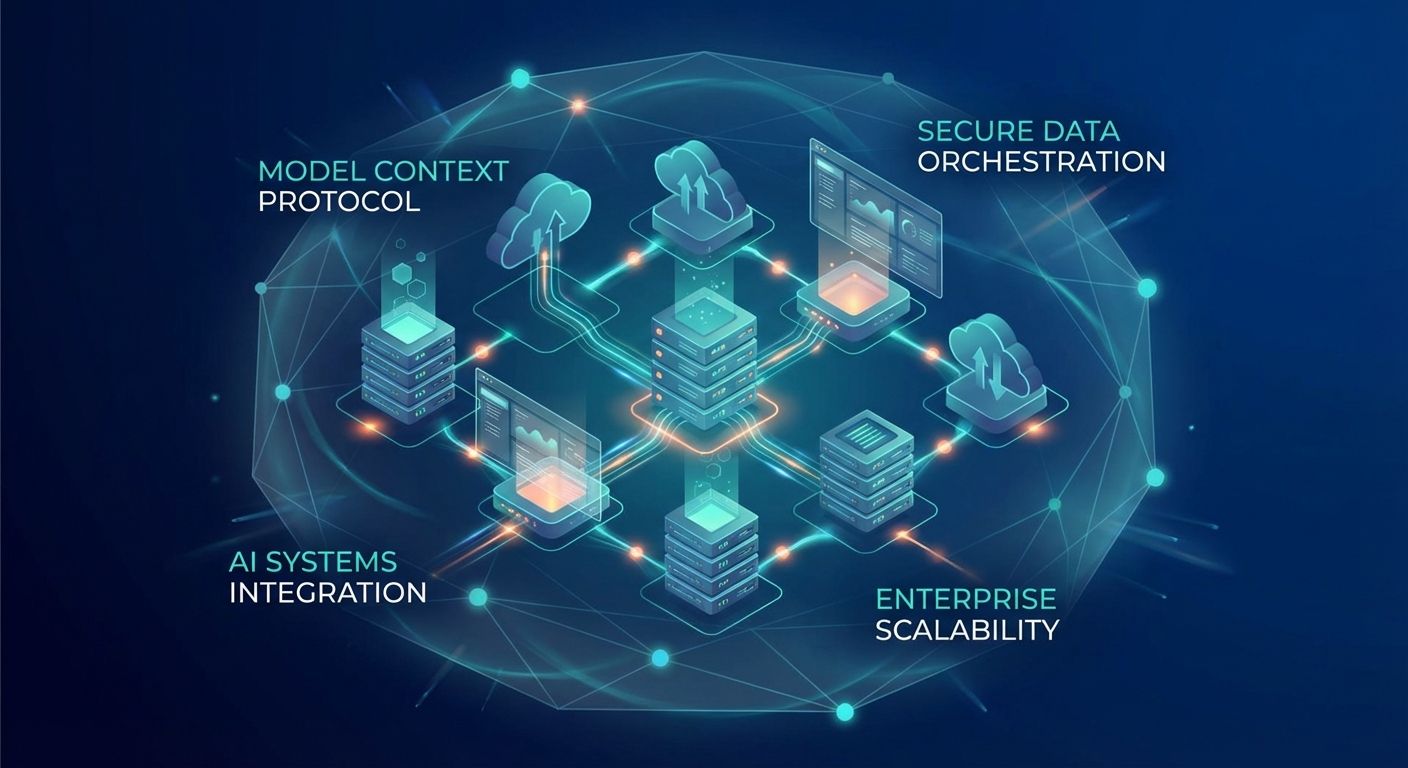
In November 2024, Anthropic released an open standard called Model Context Protocol. It defined how AI agents connect to external tools and data sources. Sixteen months later, MCP reached 97 million monthly SDK downloads and 5,800+ community-built servers. Every major AI provider - Anthropic, OpenAI, Google DeepMind, Microsoft, and AWS - has adopted it.
MCP did in 16 months what REST APIs took several years to accomplish. It became default infrastructure for a new category of computing.
For enterprise teams evaluating AI strategy, MCP is no longer optional context. It is the protocol that determines how AI agents will interact with your systems.
The Problem MCP Solves
Before MCP, every time an AI system needed to interact with an external tool - a CRM, a database, a ticketing system - developers built a custom integration. That meant learning each target system's API, writing connector code, handling authentication, managing rate limits, and maintaining everything as both systems evolved.
Multiply that by the dozens of tools in a typical enterprise stack, and you have an integration tax that consumes enormous engineering resources. Switching AI providers meant rebuilding every integration from scratch.
MCP eliminates this by separating tool implementation from model implementation. A tool gets built once as an MCP server. Any compliant AI agent - Claude, GPT-4, Gemini, or any future model - can use it without additional integration work.
How MCP Works
MCP defines a client-server architecture using JSON-RPC 2.0. The AI agent acts as the MCP client. External tools run as MCP servers.
The interaction follows a simple pattern. The agent requests a list of available tools from the server. The server responds with tool descriptions and input schemas. The agent calls tools by sending structured requests with parameters. The server executes the logic and returns results.
Three primitives handle different agent needs. Tools are callable functions that take parameters and return results - similar to API endpoints. Resources are readable data sources that agents request by URI - files, database tables, API responses. Prompts are reusable instruction templates that encode best practices for using the server's capabilities.
The protocol runs over two transport layers. Stdio for local processes (tools running on the same machine as the agent) and HTTP with Server-Sent Events for remote servers. This supports both local development and production cloud deployments.
The Ecosystem - 5,800+ Servers
The MCP server ecosystem grew from a handful of reference implementations to over 5,800 servers covering every major business category.
Developer tools lead with 1,200+ servers covering GitHub, GitLab, Jira, Docker, Kubernetes, PostgreSQL, MongoDB, and every major cloud provider.
Business applications follow with 950+ servers for Salesforce, HubSpot, Notion, Confluence, Slack, Teams, Stripe, QuickBooks, and Workday.
Web and search accounts for 600+ servers including Playwright for browser automation, Brave Search, and content APIs.
AI and automation adds 450+ servers for image generation, speech processing, workflow automation via Zapier and n8n, and vector databases like Pinecone and Weaviate.
For most enterprise integration needs, an existing MCP server already exists. Custom development is only necessary for proprietary internal systems.
Why Cross-Provider Adoption Matters
The defining characteristic of MCP in 2026 is that every major AI provider supports it. This is historically rare for infrastructure standards and changes the enterprise calculation significantly.
Before MCP, choosing an AI provider locked you into that provider's tool integration format. Building integrations for Claude meant rebuilding them for GPT-4. MCP eliminates this per-provider tax. Integration work done once transfers across all compliant providers.
The adoption timeline tells the story. Anthropic launched MCP in November 2024 with about 2 million monthly downloads. OpenAI adopted it in April 2025, pushing downloads to 22 million. Microsoft integrated it into Copilot Studio in July 2025 at 45 million. AWS Bedrock added support in November 2025 at 68 million. By March 2026, all major providers were on board at 97 million.
What This Means for Enterprise Architecture
MCP changes three fundamental calculations for enterprise AI deployment.
Integration cost drops by 60-70%. Before MCP, connecting an AI agent to 10 business tools required 10 custom integrations maintained across provider updates. With MCP, each tool gets one server that works with all compliant agents. The math shifts from multiplicative to additive.
Provider lock-in decreases. When your integrations are MCP-standard, switching between Claude, GPT-4, or Gemini becomes a configuration change rather than a rebuild. This gives procurement teams meaningful negotiating leverage.
AI capability scales with the ecosystem. Every new MCP server that the community or vendors build becomes immediately available to your agents. Your AI capabilities grow without additional engineering investment.
Security and Governance
MCP's power - giving AI agents direct access to business systems - is also its primary risk surface. An MCP server with write access to a production database is a significant attack vector if improperly secured.
Production MCP deployments require OAuth 2.0 or API key authentication on all servers, service accounts with minimal permissions, separation of read and write tools with different authorization levels, complete audit logging of all tool invocations, rate limiting per agent and per tool, and input sanitization to prevent prompt injection through external data.
Anthropic's roadmap includes OAuth 2.1 with enterprise identity provider integration (Okta, Azure AD) shipping in Q2 2026, which will address the remaining authentication gaps for regulated industries.
Where MCP Is Heading
Three developments on the MCP roadmap for 2026 will shape enterprise adoption.
Enterprise authentication (Q2 2026) adds OAuth 2.1 flows with PKCE for browser-based agents and SAML/OIDC integration for enterprise identity providers. This unlocks deployments in regulated industries that require enterprise-grade auth.
Agent-to-agent coordination (Q3 2026) enables one agent to call another through MCP, as if the second agent were a tool server. This creates hierarchical agent architectures where orchestrator agents delegate to specialized sub-agents.
MCP Registry (Q4 2026) provides a curated, verified server directory with security audits, usage statistics, and SLA commitments. Enterprise teams will evaluate servers against security requirements before deployment.
Getting Started
The practical entry point depends on your role.
For engineering teams - start by connecting an existing MCP server to your AI development environment. The Sanity, GitHub, PostgreSQL, and Salesforce servers are well-documented starting points. Build a custom MCP server for one internal system to understand the development pattern.
For architecture teams - audit your current AI integrations. Identify which custom connectors could be replaced with MCP servers. Map your enterprise tool landscape against the 5,800+ server ecosystem to find coverage gaps.
For business leaders - ask your AI vendors about MCP compatibility. Products built on MCP-standard architecture can connect to any tool in the ecosystem. Products relying on proprietary integrations are limited by that vendor's development priorities.
MCP is infrastructure. Like REST APIs before it, the organizations that adopt it early build integration advantages that compound over time. The organizations that wait will spend more to catch up later.