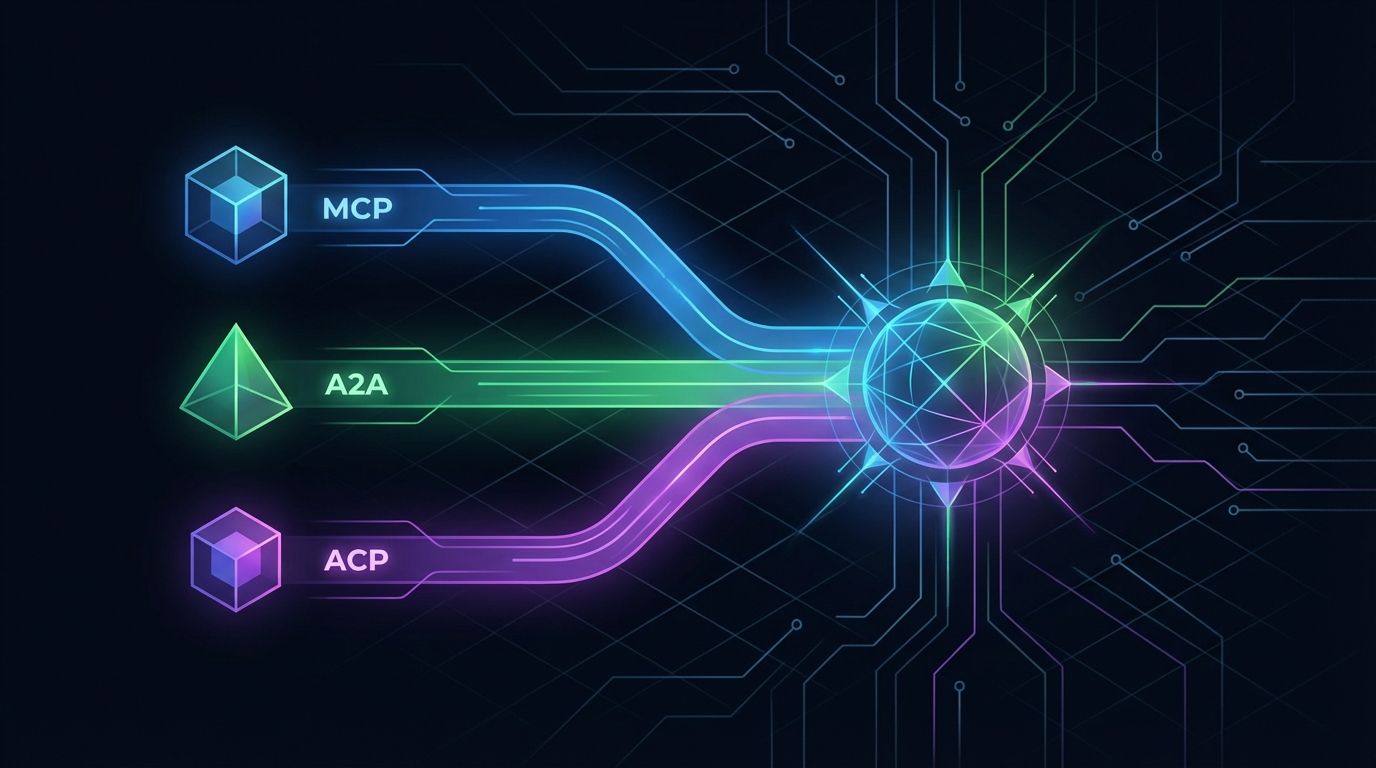
Three Standards, Three Problems
Enterprise AI agents need to solve two distinct communication challenges. First, they need to connect to external tools—databases, CRMs, APIs, file systems. Second, they need to coordinate with other agents. These are fundamentally different problems, and in 2026, three protocols have emerged to address them.
MCP (Model Context Protocol) by Anthropic handles agent-to-tool communication. It reached 97 million monthly SDK downloads and has been adopted by every major AI provider.
A2A (Agent-to-Agent Protocol) by Google defines how agents from different vendors communicate with each other. It launched with 50+ enterprise partners including Salesforce, SAP, and ServiceNow.
ACP (Agent Communication Protocol) by IBM and BeeAI focuses on inter-agent messaging with an emphasis on structured collaboration patterns.
These protocols are not competing to solve the same problem. Understanding which one does what—and when you need each—is the first step to building agent infrastructure that scales.
MCP - Connecting Agents to Tools
MCP solves the tool integration problem. Before MCP, every agent–tool connection required custom code. MCP standardizes this with a client–server architecture where tools expose themselves as MCP servers and agents connect as clients.
The protocol defines three primitives:
- Tools – callable functions
- Resources – readable data sources
- Prompts – reusable instruction templates
The simplicity is deliberate—it makes implementation straightforward and adoption fast.
With 5,800+ community-built servers covering Salesforce, SAP, GitHub, PostgreSQL, Slack, and hundreds more, most enterprise tool connections already exist as pre-built MCP servers. Custom development is only necessary for proprietary internal systems.
MCP is the most mature of the three protocols. Cross-provider adoption from Anthropic, OpenAI, Google, Microsoft, and AWS means integration work transfers across all major AI platforms.
When to use MCP – whenever an agent needs to read from or write to an external system. This is the foundation layer.
A2A - Agents Talking to Agents
Google's A2A protocol addresses a different challenge entirely. When multiple agents from different vendors need to collaborate on a task, they need a way to discover each other's capabilities, negotiate task delegation, and exchange results.
A2A introduces the concept of Agent Cards—standardized capability declarations that describe what an agent can do, what inputs it accepts, and what outputs it produces. When an orchestrator agent needs to delegate a subtask, it queries available Agent Cards to find the right specialist.
The protocol handles task lifecycle management—creating tasks, monitoring progress, streaming partial results, and handling failures. This is specifically designed for multi-agent orchestration where agents from different organizations need to work together.
A2A launched with 50+ partners including major enterprise software vendors. This matters because enterprise workflows often span systems owned by different vendors. A procurement workflow might need a Salesforce agent to check vendor history, an SAP agent to verify inventory, and a custom agent to apply company-specific approval rules.
When to use A2A – when you need agents from different vendors or organizations to collaborate on shared workflows.
ACP - Structured Agent Collaboration
IBM's ACP protocol takes a messaging-first approach to agent coordination. Where A2A focuses on task delegation and capability discovery, ACP emphasizes structured message passing between agents with defined collaboration patterns.
ACP defines message types, conversation threads, and collaboration protocols that agents follow when working together. It draws from IBM's experience with enterprise messaging systems and applies those patterns to agent communication.
The protocol is newer and has a smaller ecosystem than MCP or A2A, but its structured approach appeals to enterprises that need predictable, auditable agent interactions—particularly in regulated industries where every agent communication needs to be logged and traceable.
When to use ACP – when you need highly structured, auditable agent-to-agent communication, especially in regulated environments.
They Work Together, Not Against Each Other
The most important thing to understand about these protocols is that they solve different layers of the same stack.
An enterprise agent deployment might use all three:
- MCP connects each agent to its required tools—the CRM, the database, the document store.
- A2A enables cross-vendor agent collaboration when a workflow spans multiple systems.
- ACP provides the structured messaging layer for compliance-critical agent interactions.
Think of it like the web stack. HTTP handles data transfer. HTML handles content structure. CSS handles presentation. You would not choose one over the others—you use each where it fits.
The same pattern applies here:
- MCP is the tool integration layer.
- A2A is the agent discovery and delegation layer.
- ACP is the structured communication layer.
The question is not which protocol to pick. The question is which layers your deployment needs.
Practical Guidance
Start with MCP. Every agent deployment needs tool access. MCP is the most mature standard with the largest ecosystem. Get your agents connected to your enterprise tools first.
Add A2A when you need multi-vendor orchestration. If your workflows stay within one agent framework, you may not need A2A immediately. When you need agents from Salesforce, SAP, and custom systems to collaborate, A2A provides the coordination layer.
Consider ACP for regulated workflows. If your industry requires auditable agent communications with structured message formats, ACP's messaging-first approach provides the compliance foundation.
Watch for convergence. These protocols are evolving rapidly. The boundaries between them may blur as each expands scope. Google has acknowledged MCP compatibility in the A2A specification. Anthropic's MCP roadmap includes agent-to-agent features. By late 2026, we may see clearer integration patterns between all three.
The organizations that position well are the ones building on MCP today (it is the clear foundation layer) while designing their architecture to accommodate A2A and ACP as those ecosystems mature.